
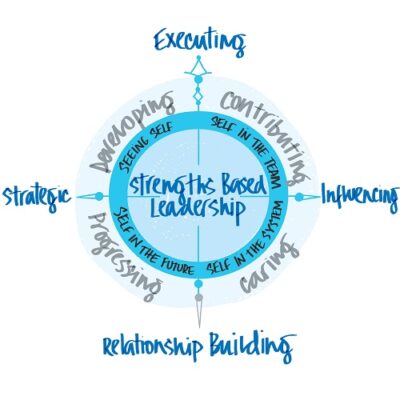
THE STRENGTHS BASED LEADERSHIP MODULE IN 3 SENTENCES
Strengths Based Leadership is an antidote to negativity and learned helplessness that often exist in deficit-based target driven systems.
Strengths Based Leadership is a journey of discovery into your strengths and the strengths of your team.
Strengths Based Leadership is an opportunity to use a strengths-based approach to problem-solving, innovation and engaging teams.
LEARNING INTENTIONS FOR THIS MODULE
Re-convene as a learning group.
Review and crystallise significant learning from How Full is Your Bucket.
Define the 4 strengths domains.
Map the Strengths of this learning community and explore impact of this on ideas for your team.
Plan to complete a Strengths Development Plan with your Thinking Partner, using the Thinking Environment framework.
UNDERPINNING THEORY
Drive: Daniel Pink.
How Full is Your Bucket: Clifton and Rath.
Strengths-Based Leadership: Conche and Rath.
Communities of Practice: Wenger.
The Development of Strengths Based Leadership
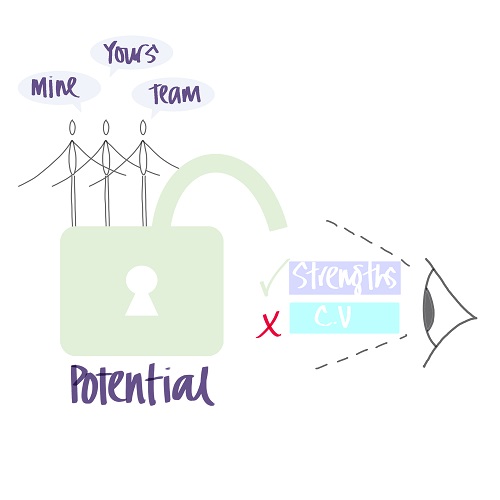
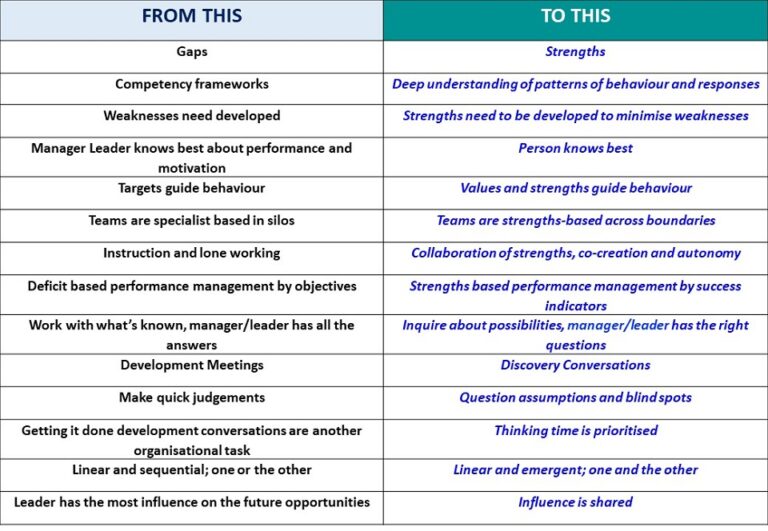
Many leaders and organisations have come to the simple but powerful realisation that to get the most out of people, you must build on their strengths. And yet, though the strengths-based approach is now conventional wisdom, the tools, and systems inside organisations such as performance appraisals, mandatory training, and succession planning systems, remain stubbornly remedial and almost exclusively focused on measuring skills and knowledge, finding gaps, and attempting to plug them. The conversation is not balanced. It’s unusual to be asked, ‘How might you use your strengths to improve your customer relationships?’ and more usual to be told, ‘You need to improve how you engage with customers. I suggest XYZ training and development’.
Strengths-based leadership is rooted in positive psychology and assumes that every person has their own specific combination of signature strengths that allow them to perform at their best (and that magnifying these strengths instead of repairing weaknesses helps people to be more productive and proficient. Strengths-based leaders help people to identify, utilise and develop their strengths.
Instead of ignoring weaknesses, strengths-based leaders make weaknesses less relevant by allocating tasks according to employees’ strengths and by stimulating collaboration between team members who have complementary strengths. Academic studies have shown that strengths-based leadership is associated with increased personal well-being, creativity, psychological well-being, performance, reduced burnout and absenteeism.
The strengths approach and the associated processes that we will share in this toolbox are aligned to a process called Appreciative Inquiry. In a nutshell this process is an individual and organisational mindset based on what’s working. It does not avoid challenging conversations, but shifts the starting point to thinking about how strengths can be used to ’fix’ things rather than the deficit based problem solving approach.
The short video touches the key theory.
The short video below gives a snapshot of the book Strengths Based Leadership which is a companion text to the Clifton Strengths Finder which you will be completing as part of this programme.
If you like to explore the academic underpinning theory and research, then please download the article below which explores the development of the Strengths Based Approach.
The Journey to a Strengths Based Approach
There is an appreciation that individuals discovering their strengths is not enough.
TAKING THE STRENGTHS ASSESSMENT
Each leader will access a code to complete an online Strengths Assessment called the Clifton Strengths Finder. You will access this via a textbook called ‘How Full is Your Bucket’ You will need a new hardbacked copy of the Anniversary Edition. The book underpins the philosophy and the assessment is available at the back of the book in an orange envelope.
Either way the assessment will provide you with a report of your top 5 strengths.
The short video below gives a snapshot of how the Clifton Strengths Finder was developed.
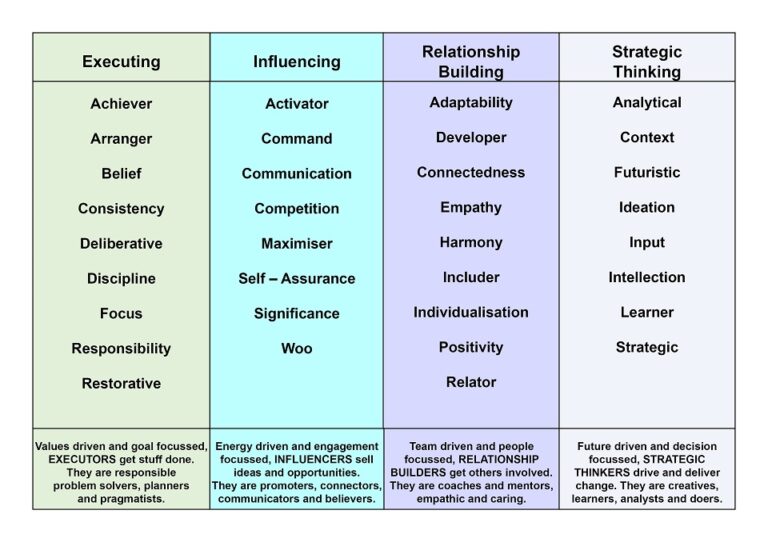
These may fall across the 4 domains shown below, only be in one domain or be across one or two – the assessment is unique to you and there are no right or wrong answers.
- Executing: People with strengths in this key domain know how to rally around a goal and get things done. Differing strengths might dictate the style of getting to the goal, but people who have strengths in this area make a massive contribution to things happening.
- Influencing: People with strengths in this key domain know how to share and embed the team’s ideas both inside and outside the organisation. These people are natural persuaders, inspire others to adopt their ideas and are vital to moving teams forward in communities.
- Relationship Building: Those with strengths in this domain tend to keep groups together. They’re the social glue: the mortar between the foundation building blocks. They know how to create and maintain groups such that the whole is much greater than its parts.
- Strategic Thinking: People with strengths in this domain tend to force the group to look at the big picture and toward the future – what might be. Always reviewing the data and applying what they learn, strategic thinkers move the organisation forward – stretching its members to think beyond what, to the possibilities of the future.
PRACTICAL TOOLS
Below you will find a set of practical tools to help you to develop your understanding of the strengths profile. Read and use these alongside the reports you received from Gallup.